Marketing is usually the first thing to slip, and it slips for a specific reason.
It isn't that you don't know what to do. You know the blog should go out weekly. You know the abandoned-cart email would pay for itself. You know you haven't looked at what your competitors changed since spring. Every one of those is a real job, and every one of them loses — every single week — to the customer who needs an answer today.
So marketing becomes the thing you'll get to. And "get to it" never arrives, because the work that shouts always beats the work that compounds.
The honest fix isn't discipline. It's people. And until now, people meant hiring.
What shipped this week
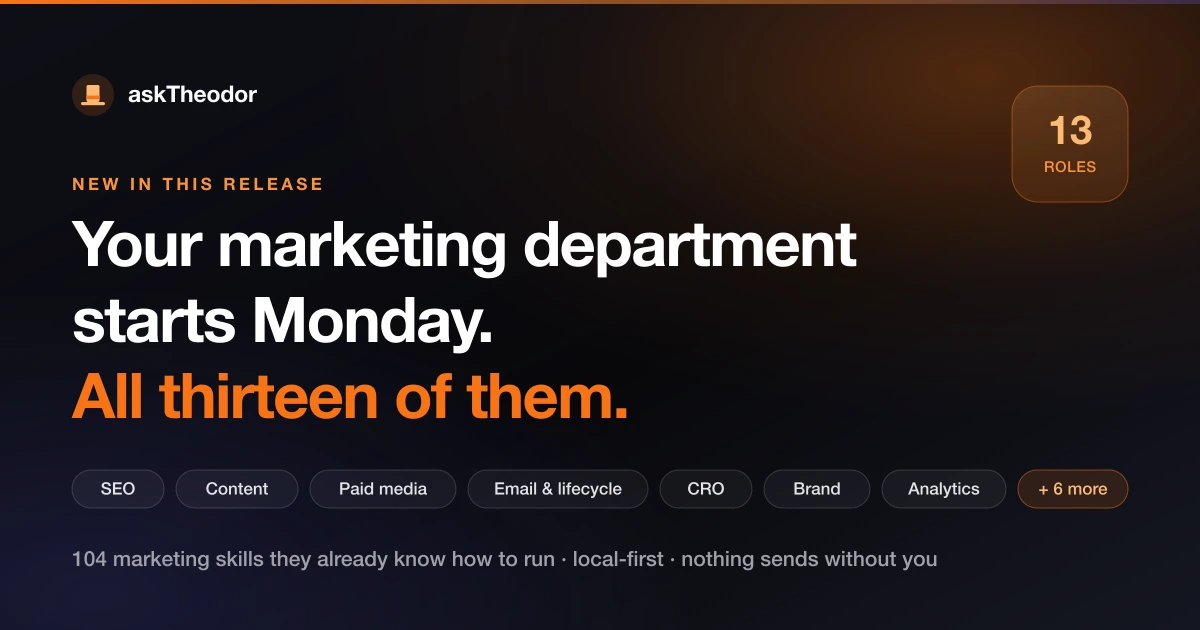
askTheodor's latest update adds a complete marketing department you can hire in about a minute.
Thirteen specialist roles, each arriving pre-wired with the right prompt, tools and trade skills — SEO Specialist, Content Marketer, Email & Lifecycle Marketer, Paid Media Buyer, Conversion Rate Optimizer, Growth Marketer, Brand Manager, CRM & Automation Manager, Influencer Marketing Manager, Marketing Analyst, Localization Marketer, Competitive Intelligence Analyst, and a Marketing Operations Manager.
104 marketing skills they already know how to run — not prompt templates you have to fill in, but written procedures with steps, judgement calls, and the mistakes to avoid.
You can hire them one at a time from Workers → Browse Catalog, or take the whole department in one click: the Marketing Team in the Company Wizard now builds all thirteen, organised, with routines attached.
What they can actually do
Not a feature list — a list of jobs that were waiting on you.
Get found. Keyword research and clustering, on-page and technical SEO audits, content briefs written from what's actually ranking, internal linking, schema, sitemaps and redirects. Plus the newer half of search: answer-engine optimisation — auditing whether your pages get cited in AI-generated answers, and monitoring your presence there over time. Local businesses get their own set: Google Business Profile, citations, NAP consistency, the local pack.
Publish consistently. A content calendar with owners and cadence, briefs that carry an actual angle, drafting, editing, and repurposing one long piece into a week of channel-native posts. Case studies, video scripts, webinar plans. When your CMS is connected, publishing straight to it — with the SEO fields filled in.
Turn a list into revenue. Lifecycle journeys mapped stage by stage, welcome and nurture and win-back sequences, segmentation from real behaviour, broadcasts, SMS. Each one with an exit condition, so nobody gets a "come back!" email the day after they came back.
Spend without guessing. Media plans, campaign structure, ad creative concepts and variants, creative-testing frameworks, budget pacing, and reallocation based on what the next euro actually returns — not the blended average that hides a saturated winner.
Convert the traffic you already have. Landing-page audits that find the friction, A/B test plans with one variable and an honest sample size, funnel audits that name the leak worth fixing first.
Know what happened. Performance and attribution reports that lead with the decision — scale this, cut that, run this experiment next — with the attribution model stated out loud and its blind spots named. Cohort analysis, churn risk, anomaly scans, and an executive dashboard of the few numbers that matter.
Watch the market. Competitor teardowns built from what they do — pricing pages, review sites, shipping cadence, job posts — not what their About page claims. Ongoing monitoring, alerts, share of voice.
Protect the brand. A brand foundation in the Library that every worker inherits, message testing, review responses, PR pitches, crisis comms, and a claim-verification pass before anything with a number or a superlative goes out.
Go somewhere new. Campaign localisation that adapts idiom and culture instead of translating word-for-word, and language audits to keep the voice recognisable across markets.
And if you run marketing for clients: onboarding, proposals, client reports and scope sign-off documents are in there too.
The part that makes it safe to leave running
Every one of those workers operates behind the same rules as the rest of askTheodor.
Nothing goes out without you. An email is drafted, not sent. A post is staged, not published. A paid campaign is prepared as a recommendation, because launching it spends your money. You approve, then it happens.
Your data stays yours. askTheodor is local-first — your Library, your brand guidelines, your customer notes live on your machine, not on our servers. You bring your own AI provider key, and only the prompts leave.
They tell you what they can't see. If Google Analytics isn't connected, the report says so rather than inventing a number. If there's no SEO tool linked, the keyword work is labelled directional and grounded in the live search results instead. That honesty is built into the skills themselves.
To connect the tools you already pay for, this update also adds one-click setups for Klaviyo, Customer.io, ActiveCampaign, Kit, beehiiv, Ahrefs, DataForSEO, Webflow, Contentful and Plausible — alongside the HubSpot, Mailchimp, Brevo, SendGrid, WordPress and Shopify connections already there.
Where to start
Don't hire all thirteen on day one. Pick the job that's been slipping longest.
- Update the app (Settings → 🔄 Updates), or download it fresh from the site.
- Install the Marketing Team from the Company Wizard — even if you only plan to use two of them, seeing how a real department fits together is worth the minute.
- Give one worker one real task. "Audit this landing page." "Brief a post on X." "What did our three competitors change this quarter?" Judge it on that.
Then open a chat with Theodor and tell him what your business actually does. He'll tell you which of the thirteen are worth your time — and which ones you can ignore.
askTheodor runs on macOS, Windows and Linux, with a 7-day free trial. Your workers, your machine, your keys.