The team you couldn't afford. Working while you sleep.
Hire AI workers for every role — sales, ops, research, content. Give them the job; approve what they send. It runs on your machine, your data stays yours, and nothing goes out without your yes.
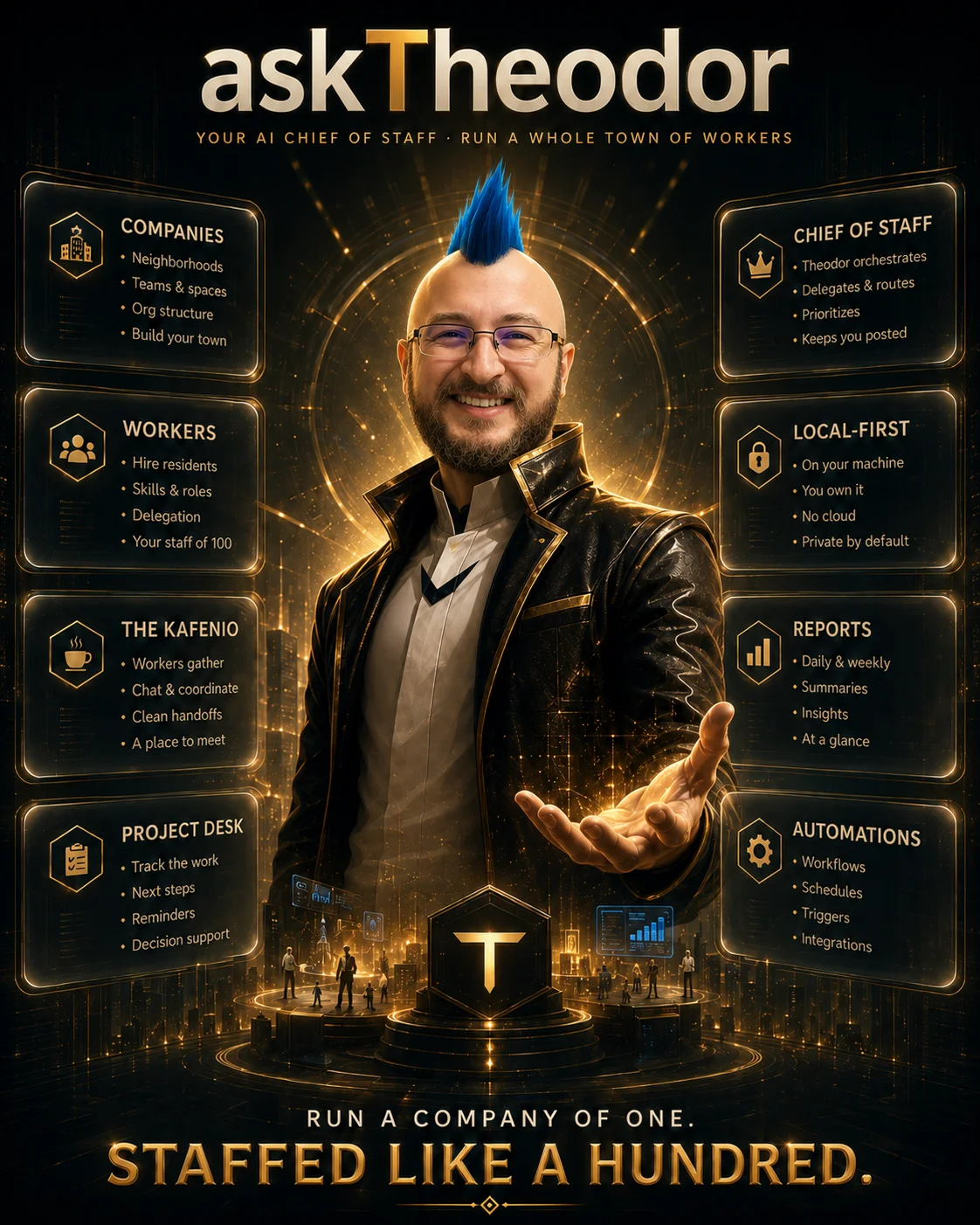
The chief of staff with the blue mohawk.
Theodor runs your town of workers: he hires from 95 professions, delegates to whoever fits the job, keeps the Kafenio humming, and reports back in plain numbers. You approve what leaves the building — he handles the rest.
- ✓ Orchestrates companies, workers, plans and routines
- ✓ Local-first — on your machine, private by default
- ✓ Daily reports, approvals queue, full audit trail
You're the founder. And everyone else.
Sales, support, ops, the books — all you, all before lunch. A real hire costs thousands a month; a virtual assistant still needs managing. So the work only you can do keeps getting pushed to 9pm.
You're sales, support, ops, and finance — switching roles a dozen times a day, doing none of them justice.
A junior hire is thousands a month and months to ramp. A virtual assistant still needs you to manage them. So you stay the bottleneck.
Replies, quotes, follow-ups, admin — the busywork eats the hours, and the work only you can do waits until everyone else is asleep.
A workforce, organised like a real one.
askTheodor runs on your machine. A workspace holds many Companies; each Company has workers, plans, a Library, and a chief-of-staff who can spawn specialists, run plans, and summarise the week.
-
✓
Companies
Group workers, files, and conversations by client / project / domain. Each scope keeps its own Library + RAG index.
-
✓
Plans (DAG)
Big asks become a directed graph of tasks. The scheduler runs them as dependencies clear, retries failures, and reports a summary.
-
✓
Memory + Library
Every artefact lands in a tagged, searchable Library. Workers cite their sources. You open the doc with one click.
Watch the workforce work.
Scroll to follow a single task from ask to shipped — Theodor hands it off, a worker carries it out, and the result lands in your Library.
Work flows between your agents.
Theodor hands each task to the right worker and the results flow back — and when you connect one, an allied external agent joins the very same mesh. Every hop is logged, budgeted, and yours to pause.
Built for actual workdays.
Every worker keeps a private long-term memory + a shared Library. Yesterday's context shows up in today's chat without you re-pasting.
Theodor splits a big ask into tasks and routes each one to the right specialist. You approve plans; the scheduler runs the DAG.
Your prompts, files, embeddings, and credentials live on your machine. Use cloud LLMs for speed, or switch to local Ollama for absolute privacy.
Every doc your workers produce is auto-indexed. Search by meaning, not just by filename. Workers cite their sources in replies.
Workers keep going while you sleep. A daily digest tells you what shipped overnight — clickable, scoped, comprehensible.
Talk to a worker over voice; have replies read back. Per-persona voice profiles so each worker sounds like themselves.
Workers run a dev server, deploy over SSH, parse spreadsheets and PDFs, and search a codebase — persistent processes, ssh/scp, structured-file reading. Real ops, not just chat.
Stand up specialized askTheodor instances on your servers over SSH — Deep Research, DevOps, Marketing, or a full clone — running 24/7 and reporting back to you.
Guided plans + playbooks take you from idea to live: research, build & deploy a site, content, payments. Spin up a ready-made Creator-Studio team in one click.
Workers, not assistants.
Every persona has a name, a remit, a tool belt, and a voice. They take work from you, hand it to each other, and report back when they're done.
Workspace-wide. Splits work, picks specialists, reports back.
Owns the Library, RAG freshness, auto-categorisation.
Routes image + video briefs to the right generation provider.
Pick a persona from the catalog, or write one — they remember.
See how it all fits together.
A growing library of infographics — the workforce, the privacy model, the tools, the playbooks. One glance each.
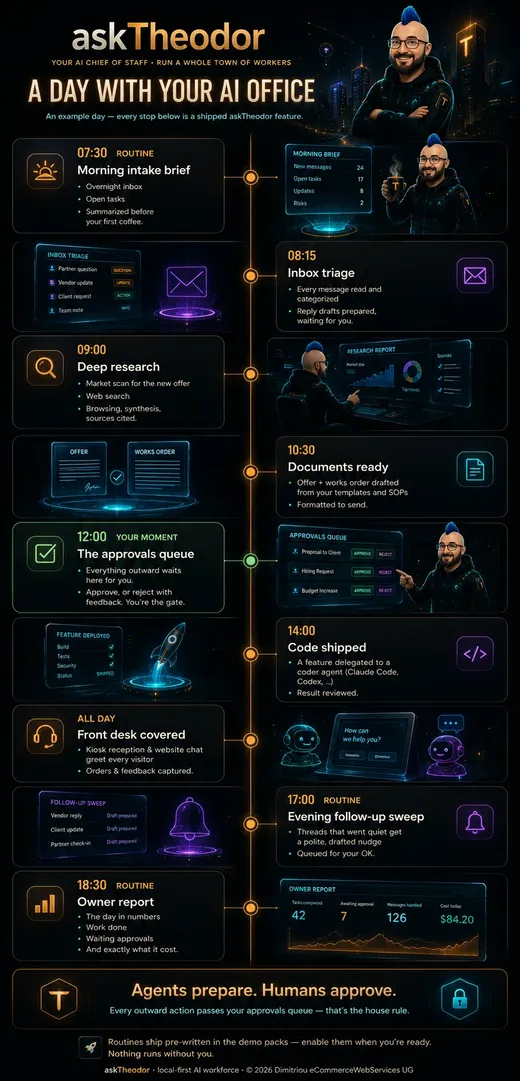 Story
Story From the 07:30 intake brief to the 18:30 owner report — a full day of work flowing through your local AI team.
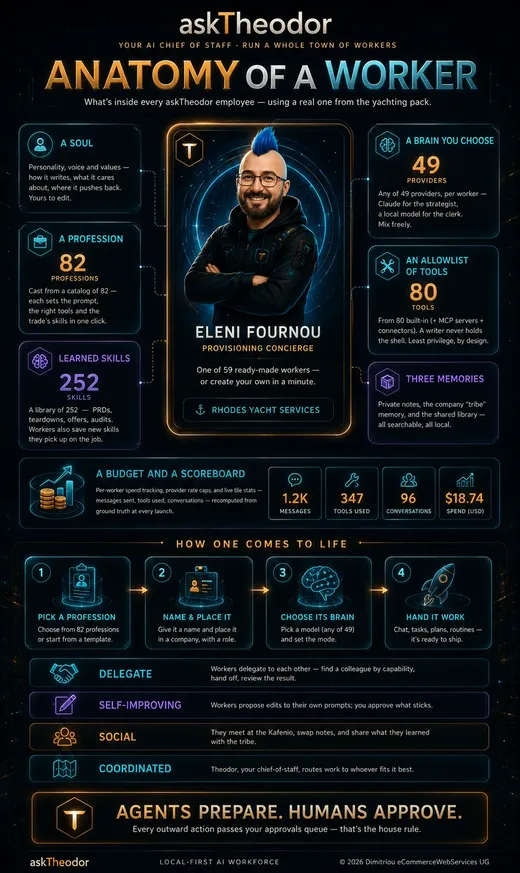 Concept
 What's inside every askTheodor employee — a soul, a profession, learned skills, a brain you choose, and a tool allowlist.
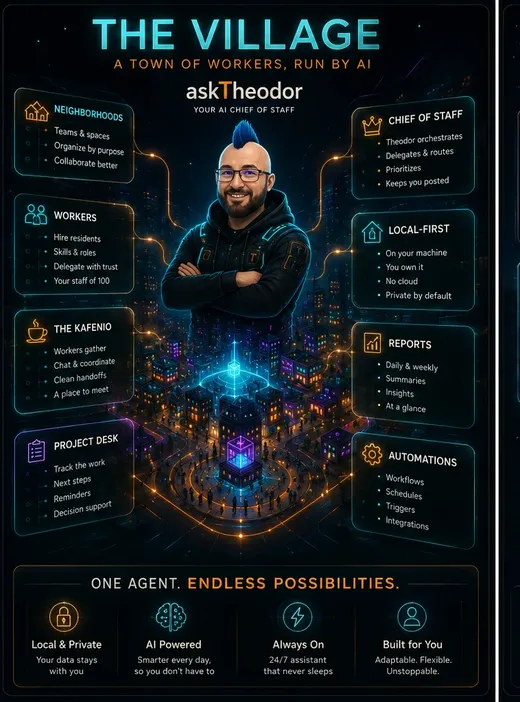 Concept
 A town of workers, run by AI — how Theodor and the specialists are organised into a workforce that delegates like a real one.
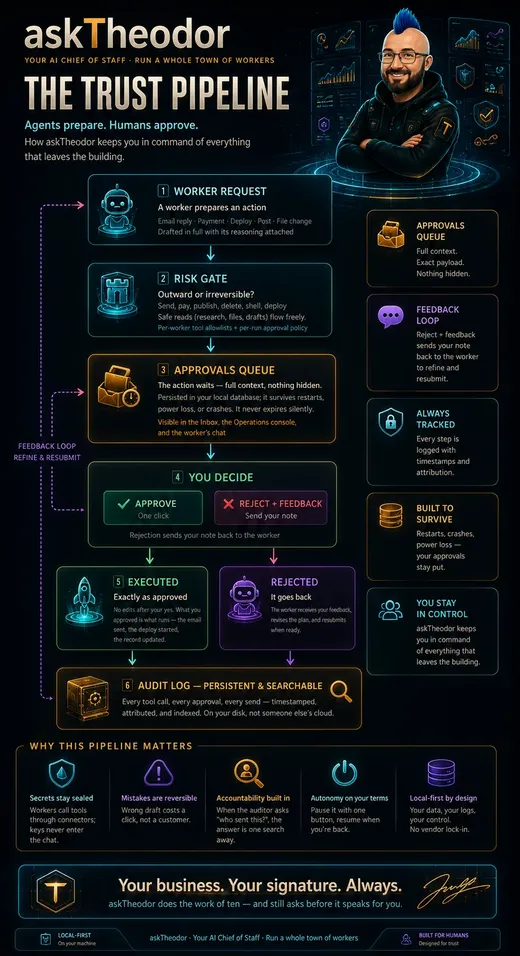 How it works
 Agents prepare, humans approve: the risk gate, the approvals queue, and the audit log that keep you in command.
An organised workforce, on your laptop.
saved each week by handing routine work to a worker who remembers yesterday.
cheaper than hiring a junior generalist. One subscription covers every worker — and you bring your own LLM keys.
to onboard a new worker. Pick a persona, give them a remit, ship.
Numbers above are illustrative — based on early-user feedback. Your mileage will vary by workflow.
Most AI tools rent you a chatbot. This one staffs a company.
The agentic space splits into four shapes. They're good at different things — here's where askTheodor actually differs, and where it doesn't.
| askTheodor Desktop AI workforce | Chat assistants ChatGPT · Claude · Copilot | Cloud agent platforms Lindy · Relevance AI · Manus | Automation & frameworks Zapier · n8n · CrewAI | |
|---|---|---|---|---|
| Where it runs | On your machine — a native desktop app | Vendor's cloud | Vendor's cloud | Cloud, or self-host (n8n, frameworks) |
| Where your data lives | Your disk. Only prompts reach the model | Vendor's servers | Vendor's servers | Wherever you host it |
| Shape of the thing | A staffed company — workers, org chart, delegation | One assistant you prompt | Agents you configure, often per task | Workflows / code you build |
| Runs while you're away | Yes — routines, plans, and a 24/7 hub on your own server | Limited (scheduled tasks) | Yes | Yes |
| Which model thinks | Any — your own keys, per worker. Or a local model, offline | The vendor's own model | Platform's choice; some allow your keys | Your choice |
| What you pay | One flat licence + your own model usage | Per seat, monthly | Seats, credits or per-action metering | Per task/run, or free + your hosting |
| Before anything is sent | Drafts only — an approval gate, a kill-switch, a full audit log | You're in the chat anyway | Varies by platform | Whatever you build |
| Setup cost | Install, connect a key, hire a worker | Just sign in | Sign up, connect apps | Build it yourself (often technical) |
Where askTheodor wins
When the work is confidential, when you want a team with memory and reporting lines rather than one clever assistant, when you'd rather pay once and bring your own model keys, and when nothing may go out without your yes.
Where the others win
Nothing to install and no machine to keep awake. Long lists of managed integrations maintained for you. If you want one quick answer, a chat assistant is faster — and for a single deterministic workflow, an automation tool is the simpler tool.
Compared by category rather than product because these tools change weekly; the traits above are structural. Accurate to the best of our knowledge in July 2026 from each vendor's public documentation — spot something out of date? Tell us and we'll fix it. All trademarks belong to their owners.
One subscription. Every feature.
Download free and use everything for 7 days. After that, a license unlocks the app. No feature tiers — every capability is in the single plan. Buying for a team? Choose how many licenses you need and each teammate gets their own key.
plus 19% VAT
Billed monthly. Cancel any time. All features included.
or download the free 7-day trial →plus 19% VAT
10€/month effective. Billed once a year. All features included.
or download the free 7-day trial →plus 19% VAT
Run askTheodor as a 24/7 touch-screen receptionist — hotels, lobbies, entrance halls — multilingual and voice-ready. One subscription hosts several concurrent kiosks; each live kiosk is +50€/mo.
plus 19% VAT
Run a headless askTheodor on your own server, 24/7 — it keeps working your Plans, researches, drafts replies, and reports back to your desktop. Deploy it straight from the app's Fleet panel; each concurrent instance is +10€/mo.
Prices shown are net; the applicable VAT is added at checkout. By purchasing you accept our Terms and Right of Withdrawal. See also our Privacy Policy.
Teams & Enterprise — shared workspaces, SSO, and admin controls — are on the roadmap for the next few months.
Or we set it up for you
The software is the easy part. If nobody on your team has time to evaluate it, we install askTheodor on your machines, build your first four workers around your own documents, and train your team in a two-hour workshop.
Scoped and quoted per case — you get a fixed price in writing before anything starts. German or English.
The honest answers.
What does it actually cost to run? I bring my own API key. +
The licence is fixed. What varies is what your workers spend at your AI provider — and that depends far more on which model you pick than on how much you use it.
Rough, honest orders of magnitude for typical small-business use: a daily inbox digest or a short research task on a cheap model (Haiku, GPT-nano, Gemini Flash) usually lands in low single-digit euros a month. Push the same work through a frontier model (Opus, GPT-5.6 Sol) and it can be 10–30× that. Long research runs and image generation are the two things that actually add up.
Three things keep it in your control: a monthly budget cap with a hard stop, per-tool call limits, and a real cost ledger showing spend per worker and per Company. And if you'd rather spend nothing at all, run a local model through Ollama — then inference is free and your data never leaves the machine.
We can't quote your exact bill — nobody honestly can, because it depends on your model choice and volume. What we can do is show you every cent as it's spent and let you cap it.
Is my data really private? +
Your workspace — companies, workers, conversations, Library documents and memories — lives in a database on your own machine. We don't host it, can't read it, and it isn't synced to us.
The honest caveat: if you connect a cloud AI provider, the prompts for that request go to that provider, because that's how the model thinks. Your files aren't uploaded wholesale — only the relevant context for the task. If you need nothing to leave the machine at all, run a local model and it won't.
Provider API keys are stored encrypted at rest, not in plain text.
I don't have an API key. Can I still use it? +
Yes. askTheodor ships with a small model built in, so it works the moment you install it. It's modest — fine for trying the workflow, not for your best work.
For real work you have two free-ish paths: install Ollama and run an open model on your own hardware (no key, no per-token cost), or add one cloud key — most providers are pay-as-you-go with no minimum.
Will it send emails or post things without me? +
No. Outbound actions are drafted and held for your approval — an email is written, not sent; a post is staged, not published. That's the default, and it's the behaviour we'd recommend keeping.
There's also a single autonomy switch that pauses every unattended worker at once, and an audit log of every action taken.
Does it work offline? +
The app itself runs entirely on your machine, so your workspace opens with no connection. Whether a worker can think offline depends on its brain: a local model (Ollama, or the built-in one) works with the network off; a cloud model obviously needs the internet.
What happens when the 7-day trial ends? +
Nothing is deleted. The app asks for a licence key to keep working; your companies, workers and Library stay exactly where they are and come straight back when you activate.
Updates are never blocked behind a licence, and you can export a full backup at any time — including before you decide.
Is this just a wrapper around ChatGPT? +
It's a different shape of thing. A chat assistant gives you one model in one thread. askTheodor gives you a staffed company — workers with their own memory, tools and reporting lines, running multi-step Plans and scheduled Routines on your machine, with approval gates in front of anything consequential.
And the model underneath is your choice — any provider, per worker, or a local one. If a one-off question is all you need, honestly, a chat assistant is the faster tool.
Something we didn't answer? Ask us directly — a human replies.
Bring your workforce home.
Download free, try every feature for 7 days, then 12€/month or 120€/year unlocks it. Bring your own LLM keys — we never see them.